Interoperability at scale: from competition to collaboration
EV charging has reached a point where simply being connected is no longer a differentiator. Connectivity is the foundation: drivers expect a complete experience in which everything works seamlessly and reliably and is always available. The last thing they want is to be stranded somewhere with no way of charging their vehicle. As a result, the entire charging experience must be perfect prior to the product's launch. What increasingly distinguishes mature platforms from fragile ones is not whether they support roaming, but rather how roaming works in practice.
25 February 2026
At a glance
In the previous article, we discussed the hidden machinery behind roaming as a service. This article explains why outsourcing roaming as a service may be the best option for your company if you don't have – or want to spend – the necessary resources for roaming. Furthermore, this article will focus on the various ways that collaboration is important.
Roaming is where interoperability stops being theoretical. It is the moment where multiple systems – CPO backends, MSP platforms, pricing engines, billing flows, and support processes – must act as one. A charging station and a payment method may each work perfectly in isolation, but roaming exposes whether those systems truly function as a single ecosystem or whether the cracks only appear when a real driver tries to charge, pay, and leave.
How well do your systems actually work together?
Interoperability is often treated as a technical milestone: you support OCPI or OICP, you connect to a roaming hub, and the box is ticked. But protocol support alone says very little about how well your ecosystem actually functions in day-to-day operations. Being “connected” only confirms that data can move between systems, not that it does so reliably, consistently, or in a way that supports real business processes.
In roaming, true interoperability is visible in the details. It also surfaces in less visible but equally critical areas: support workflows, dispute resolution, and liability handling. A single failed roaming session can trigger multiple support tickets, billing disputes, or delayed payments if assumptions between systems don’t align.
This is where real-world friction emerges. Tariffs arrive late – or not at all. Protocols are implemented slightly differently by each party, creating edge cases that only appear at scale. Roaming hubs reduce initial complexity, but don’t eliminate it; mismatched data, partial implementations, or missing fields still require manual checks, spreadsheets, and workarounds to keep revenue aligned.
The key point is simple: interoperability is not binary. A network can be fully “roaming-enabled” and still operationally fragmented. Roaming doesn’t just connect systems – it amplifies their weaknesses. Without alignment across data, processes, and accountability, “connected” ecosystems struggle to operate sustainably.
From competition to collaboration
The EV charging market has moved beyond the phase of isolated, self-contained networks. Scale, coverage, and reliability are no longer achieved by going it alone, as roaming only works when ecosystem players accept a level of interdependence. That means recognising that no single CPO, MSP, or platform controls the full charging journey and that long-term success depends on how well these roles work together rather than compete at every interface.
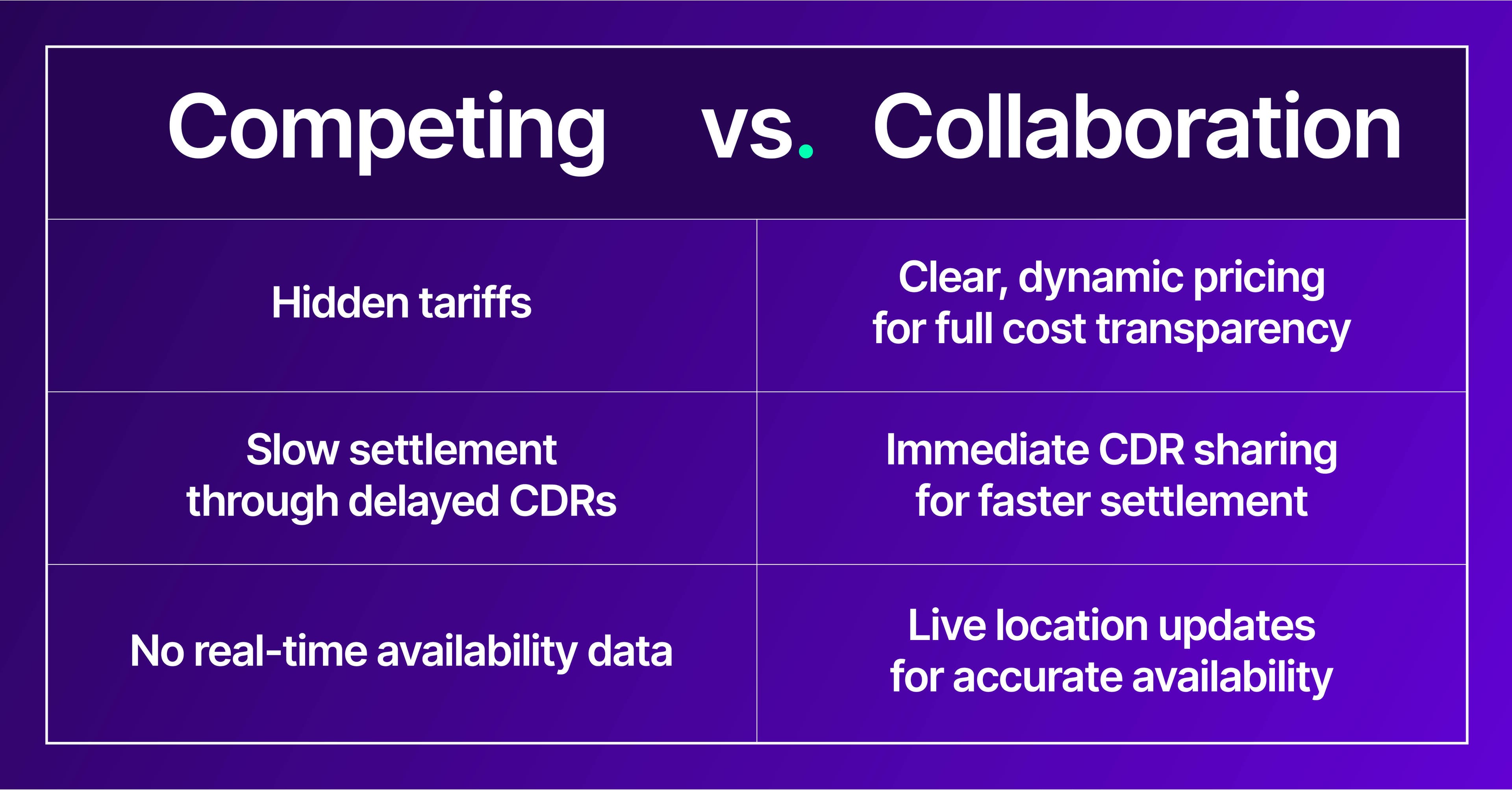
Yet roaming also exposes competitive instincts. Withholding tariff data, selectively implementing protocol modules, or stacking margins deep in the roaming chain may create short-term leverage, but they fragment the experience for drivers and partners alike. The result is slower onboarding, higher support costs, and lower utilisation.
Recent developments such as grid-aware charging make this lack of coordination even more visible. When grid operators temporarily reduce charging power to relieve network congestion, charging sessions take longer by design. Yet in many roaming setups, time-based overstay or blocking fees continue to apply unchanged. The result is a driver being charged extra for a longer session, even though the extended duration is caused by external constraints beyond their control. This is not the failure of any single party, but the result of poorly implemented roaming technology. Many MSPs apply fixed or time-based fees that are disconnected from the actual charging process and costs. As a consequence, drivers absorb the impact: they pay more while dealing with a partially charged vehicle – leaving them penalised for limitations entirely outside their control.
Collaborative models take a different approach. By optimising the entire chain – from tariff publication to settlement and support – ecosystem players reduce friction for each other and for the driver. The result is faster market growth, because onboarding partners and expanding coverage becomes easier; a better driver experience, because pricing and availability are clearer and more reliable; and, over time, healthier margins, as trust replaces inefficiency and scale offsets the need for defensive pricing strategies. In a mature EV market, collaboration is no longer a “nice to have” – it’s the condition that makes roaming sustainable at all.
Many companies can build things; be the one that makes things work
Many companies can build roaming connections. Far fewer can operate roaming at scale. Supporting a protocol is only the starting point; running a roaming ecosystem requires continuous operational execution across legal, finance, and support.
This is where the real cost of “building it yourself” becomes visible. Managing dozens or even hundreds of roaming contracts, handling disputes across borders, absorbing payment delays or non-payment risks, and keeping up with evolving protocol versions all demand dedicated teams and infrastructure. These costs rarely show up in demos or roadmaps; they surface in failed sessions, blocked invoices, and cash-flow pressure.
The real value lies in removing that burden. Making roaming work means turning complexity into reliability: predictable revenue, fewer disputes, and a consistent experience for drivers and partners. That is the difference between having roaming on paper and having roaming that actually scales.
The future, Road’s version
Road sees the future of roaming not as a one-off integration but as a modular, managed layer that evolves alongside the market. Roaming should not be something you “set up once and forget”, but a living part of the ecosystem that continuously adapts to new partners, changing standards, and increasing scale. That means designing interoperability into the foundation, rather than treating it as an afterthought once systems are already live.
This vision is guided by a few core principles:
-
Reducing points of failure instead of adding layers of complexity;
-
Minimising manual processes that do not scale;
-
Prioritising the quality of connections over sheer quantity.
More connections only create value when they are reliable, consistent, and operationally sound. From that perspective, Road’s direction is clear – using smarter routing strategies, combining hubs and peer-to-peer connections where each makes the most sense, improving data consistency end to end, and gradually reducing dependency on fragmented roaming hub structures when they become a bottleneck.
The end goal is roaming that scales with the market instead of slowing it down: an ecosystem where growth doesn’t introduce more friction but is supported by a resilient, well-managed roaming layer that keeps pace with the demands of operators, partners, and drivers alike.
The commercial benefits of getting interoperability right
When roaming and interoperability truly work, the benefits extend far beyond technology. Companies can expand faster without sacrificing coverage, adding new partners and markets without lengthy custom integrations.
Operational overhead drops as workarounds decrease. Legal teams handle fewer disputes, finance teams face fewer corrections and delays, and support teams spend less time resolving avoidable roaming issues. Financial risk is reduced as settlement becomes more predictable and cash-flow gaps caused by disputes or non-payment shrink.
Most importantly, the driver experience improves. Because ultimately, the biggest upside shows up at the charger. Clear pricing, reliable session handling, and fewer failures translate into a better driver experience – one that encourages repeat usage and higher utilisation. And higher utilisation is what turns roaming from a necessary cost into a stronger, more sustainable return on investment.
Interoperability as a strategic choice
Interoperability is ultimately a strategic choice, not a technical one. The question is no longer whether you can connect to a roaming network, because most players can. The real question is whether you want to manage the operational, legal, and financial complexity that comes with making those connections work at scale, day in and day out.
Done right, interoperability becomes a trust signal to partners: a sign that your systems, processes, and data can be relied on. It acts as a growth enabler, removing friction as you expand into new markets or onboard new roaming relationships. Over time, it also becomes a competitive advantage – one that compounds, because every well-functioning connection strengthens the ecosystem rather than adding drag.
This is where Road’s perspective fits naturally. Not by competing on control, exclusivity, or lock-in, but by enabling collaboration in a market that increasingly depends on it. As the EV ecosystem continues to mature, the winners won’t be those with the most connections on paper, but those who turn interoperability into a foundation for sustainable growth.

15 July 2025
The illusion of ownership: buy vs build in EV charging
Everyone craves control. But in reality, a sense of ownership is often just an illusion. In EV charging, and countless other industries, the more control you think you have, the greater your risk of building the wrong thing entirely, sinking years and resources into a problem that has already been solved elsewhere.

09 January 2026
The hidden machinery behind roaming: the power of buying simplicity
What makes roaming work isn’t the protocol; it’s everything around it. Contracts, settlement, disputes, insurance, support, compliance, and constant optimisation across a fragmented European market. The power of buying simplicity is that you don’t just get roaming – you remove an entire operational department.

01 December 2025
The strategic dilemma behind EV roaming: build it or buy it?
Roaming is one of those things you have to get right, but it’s far from easy. Who do you connect with? How do you manage it all? And how do you make sure it actually works for drivers? Whilst it is one of the more difficult aspects of EV charging, it might be one of the most important ones.