The strategic dilemma behind EV roaming: build it or buy it?
Roaming is one of those things you have to get right, but it’s far from easy. Who do you connect with? How do you manage it all? And how do you make sure it actually works for drivers? Whilst it is one of the more difficult aspects of EV charging, it might be one of the most important ones.
01 December 2025
At a glance
Roaming is not just a feature; it is the most critical and essential infrastructure you must get right. Interoperability is steadily turning into the standard, but there is a long way ahead before reaching that point. That’s where you win or lose if you make the wrong decision. For this article, Road’s own Jeroen van Beek breaks it down — the realities behind roaming, why it’s so complex, and what CPOs should consider before choosing to build or buy.
Roaming as a service is a game changer for EV drivers worldwide. It creates the simplest possible way to charge – wherever and whenever – through one unified network. But achieving that simplicity is anything but simple. Roaming means that we create connectivity between different systems within the EV charging infrastructure to make sure charge cards can be used at multiple charging stations. This is a critical feature for EV drivers – but not something you can just switch on and off. Essentially, roaming creates an invisible network of thousands of connections between Mobility Service Providers (MSPs) and Charge Point Operators (CPOs).
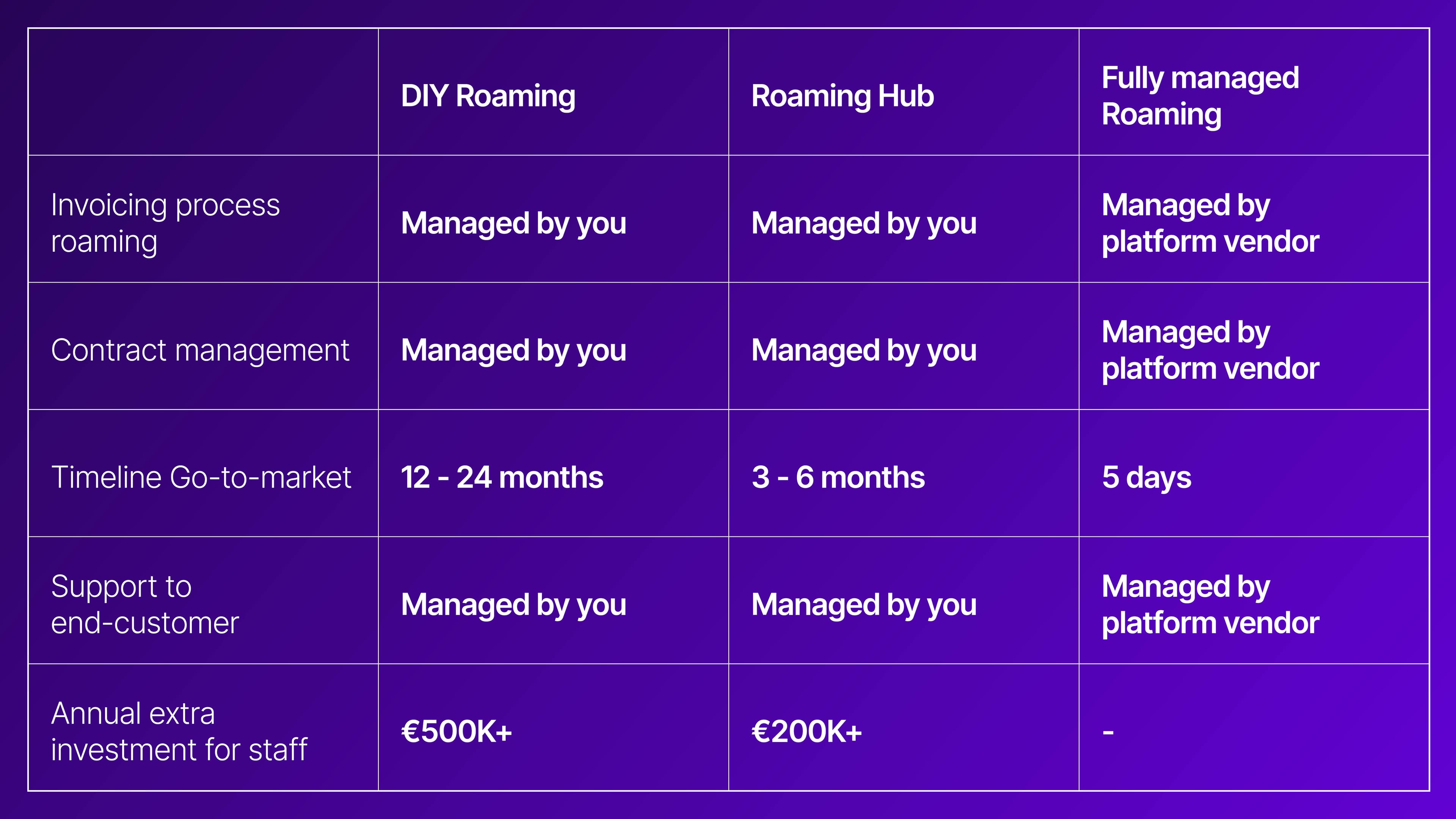
In Europe, four main roaming hubs form the backbone of interoperability: Hubject, GIREVE, e-clearing, and Enapi. Connecting to all four offers the best coverage, but it’s a process defined by negotiations, certifications, and strict technical alignment. The simplicity drivers enjoy is built on infrastructure that is anything but simple. Both CPOs and MSPs have different choices when it comes to integrating EV roaming:
Start from scratch
Building your own roaming infrastructure seems attractive because it appears to grant full autonomy over data, pricing, integrations, and customer experience. But getting there takes more than motivation. It demands patience, deep industry knowledge, and a high level of resilience. When you start from zero, every detail needs to be thought through before you can even begin. And the very first step is assembling the right team: the experts who will negotiate contracts, maintain protocol compatibility, handle billing disputes, monitor connections, resolve data issues, and keep your roaming infrastructure alive and compliant day after day.
A legal team that can carry the weight of starting from scratch;
A product manager to oversee everything;
A strong support team who are equipped to handle everything going wrong;
Finance agents to take care of billing roaming partners;
Engineers who can maintain and establish connections with roaming partners.
This might seem like just a list, but it represents everything that needs to be taken care of before going to market – before you start making revenue. Just a strong team alone can lead to over 500k of annual salary costs. And that is not just a launch cost; it is a permanent one.
As a starter, you need to focus on establishing OCPI connections, and this requires patience. If your volume is not big enough to begin with, you will be placed at the bottom of the list of companies waiting to connect.
When Road decided to offer roaming, some contracts took over a year to finalise. Beyond the legal work, technical integrations add even more time and complexity. Once you are live, maintaining stability requires continuous monitoring and issue resolution. One technical fault can cascade across the system, taking networks offline and eroding customer trust.
Hub connection
The second option is a hub connection. This means you connect your own platform to existing roaming hubs, which in turn will connect you to other CPOs and MSPs that are already part of an existing network. With this option, you are still responsible for contract negotiations and the billing of roaming sessions, but it heavily reduces the waiting time for everything to move into place. In addition, you will have to take additional costs into account: you will have to pay for setup, roaming per socket/token, and per session. This option is ideal for connectivity speed; you, however, still need to manage everything on the support and billing side. This means you need a designated team for these aspects, but everything else is taken care of.
Fully managed roaming
When you outsource roaming in full, you plug into an existing roaming infrastructure that already has all the necessary connections up and running. You do not need the fully equipped team to ensure everything works accordingly, and your connection can be set up in less than a week. With this option, all the hard labour has been done by someone else, and you mostly just enjoy the perks.
Where to begin with roaming
It all sounds ideal – broad coverage, satisfied drivers, and a seamless charging experience. But where do you actually begin? Never jump into implementing roaming without first understanding who you’re serving. Start by mapping where your drivers live, work, and travel. Even if most of your users stay within one region, many will cross borders for work, holidays, or daily commutes. Your coverage must follow them. The last thing you want is a driver stranded abroad because your network stops at the border.
Next, get your contractual groundwork in order. Yes, there are standard templates, but in practice, most of your time will be spent reaching out to roaming partners, chasing signatures, and navigating legal reviews. Contracts don’t sign themselves, and in a fragmented market, even large operators can take months to finalise agreements. The administrative and legal overhead quickly becomes one of the biggest drains on time and resources.
How to establish a network
Building a roaming network sounds straightforward, but it’s one of the most complex parts of e-mobility. Every connection involves legal, technical, and strategic work. Contracts need signing, systems need certifying, and integrations need testing. Some partnerships take quite some time before going live.
At the heart of this lies interoperability. There are standardised protocols available, but they are all implemented differently. Technical protocols are constantly evolving; with every new integration, new functionalities are released as well. It is thus not the matter of a ‘one-off’ implementation. You do not just plug in once and let it move forward; it’s a case of constant iteration. In order to get the best roaming coverage, you need to implement all different versions available, not just the latest updates, as some roaming partners will be on an older version and others will have updated to newer versions. This goes for not just OCPI, but OICP and OCHP as well.
Then comes the challenge of data and pricing management. Every session triggers multiple data exchanges, from token validation to tariff calculation and billing. One mismatch can cause failed transactions or incorrect pricing. Data accuracy is not merely a detail; it’s the backbone of roaming. Once connections are live, the work continues. Reliable roaming demands ongoing optimisation, constant monitoring, reconciliation, and maintenance. Without dedicated resources, small issues can quickly become downtime or cash flow disruptions.
Ultimately, this all connects back to the driver experience. When networks communicate smoothly, prices stay transparent, and payments are reliable, trust grows. That’s why many CPOs choose to buy rather than build: because the best roaming experience is the one drivers never have to think about.
The risks of doing it wrong
When roaming fails, the impact is immediate for drivers, partners, and your business. A single transaction error or pricing mistake can ripple through the network, delaying payments and damaging trust.
The biggest risk is loss of credibility. Drivers expect reliability; when charging doesn’t work, they see a broken promise. For CPOs, repeated issues can harm reputation and strain partner relationships.
There’s also the growing risk of security vulnerabilities and fraud. Every roaming transaction crosses multiple systems and borders. Without robust safeguards, data and payments can be exposed, turning a technical failure into a brand crisis. With that in mind, cash flow is the next risk. Billing mismatches or delays can create serious instability, especially for smaller operators. As your network scales, so do the financial exposures.
And perhaps most damaging, a poorly managed setup can limit growth. Slow onboarding, disputes, or unreliable systems make you a less attractive partner. Every integration you cannot close is a missed opportunity.
In roaming, reliability isn’t just about uptime – it’s the foundation of your business. A network that fails technically also fails commercially.
Why do CPOs face the decision to either buy or build roaming
For most CPOs, the question isn’t whether to offer roaming – it’s how. As networks scale, the choice becomes a strategic one with real impact on margins, cash flow, risk, and compliance.
Full oversight of data, pricing levers, partner integrations, and the customer experience. On paper these all seem like you are in full control of your connection. But that control comes at a cost: slower expansion, significant upfront investment, and a long tail of maintenance. At large scale, every additional integration compounds operational overhead. Outages, certification cycles, and standards updates become material risks that impact uptime, performance, and brand reputation. The margin impact of carrying this complexity in-house is often underestimated.
Choosing a managed roaming provider trades ownership for speed and stability. Instead of investing in infrastructure, certifications, and specialist teams, CPOs can focus on network growth and customer experience. A strong partner handles evolving standards, interoperability, and settlement complexity, enabling faster rollout and lower integration risk.
At scale, roaming becomes a core dependency that drives utilisation and competitiveness. Here, in-house solutions struggle under increasing technical and regulatory pressure, making a trusted partner essential for reliability and international compliance.
Ultimately, the decision comes down to strategy. If roaming isn’t your differentiator, outsourcing accelerates growth. If owning the entire customer journey matters, building may fit, but only with full awareness of the long-term maintenance burden.
The EV ecosystem changes fast. A managed partner ensures you stay aligned with new standards and demand without constant rebuilding. In short: control may seem to buy autonomy, but partnership buys momentum. It all comes down to the decision of which decision matters more to your economics and their long-term vision.
Industry trends around roaming
At Road, we also see the roaming space is evolving fast as the industry matures and standards stabilise. There’s a clear shift toward open protocols and interoperability – with OCPI driving a better connected European network.
At the same time, collaboration is growing. What used to be a web of bilateral deals is becoming structured ecosystems where CPOs, MSPs, and hubs work together to deliver scale and stability. Pricing transparency and fraud prevention are now top priorities. As volumes rise, accurate billing and data integrity are no longer operational details; they’re competitive advantages. MSPs are investing in smarter settlement tools to improve cash flow and reduce disputes.
The market is also consolidating. Smaller roaming platforms are merging or partnering to expand coverage, while white-label roaming solutions are gaining traction, allowing brands to offer seamless charging under their own name without starting from zero.
Roaming is becoming a necessity; without it, you can’t serve your customers. It’s not optional anymore.
As expectations rise, reliability and transparency are becoming the new standard. Drivers and partners alike demand consistency, and the players who deliver it will set the pace for the next phase of e-mobility.
Turning complexity into confidence
Roaming is not just a technical challenge – it’s a test of trust. Behind every smooth charging session lies a network of contracts, data, and collaboration. When it works, drivers barely notice.
When it fails, everything else does too.
That’s why the buy vs build decision matters. It’s not simply about cost or control – it’s about how quickly you can deliver reliability, transparency, and scale. Building gives you ownership. Buying gives you momentum. In a market defined by trust and speed, the ability to turn complexity into confidence might just be the biggest advantage of all.
For CPOs who want that same confidence without the operational burden, Road’s modular roaming layer absorbs the heavy lifting – contracts, settlements, technical upkeep, and ever-shifting protocols – so you don’t have to. In the end, what your drivers care about is the experience at the charger. The path you take to deliver that reliability is invisible to them, but the quality of the final product is what defines you. Let that be where your focus stays.

15 September 2025
Choosing the right platform for EV charging: a security guide for large-scale CPOs
Managing a large EV charging network comes with significant risks: from cyber threats and data misuse to evolving regulations across borders. For CPOs, security cannot be treated as a back-office function; it must be integral to business resilience. This guide outlines the key security principles and credentials to consider when selecting a SaaS partner you can trust.

15 July 2025
The illusion of ownership: buy vs build in EV charging
Everyone craves control. But in reality, a sense of ownership is often just an illusion. In EV charging, and countless other industries, the more control you think you have, the greater your risk of building the wrong thing entirely, sinking years and resources into a problem that has already been solved elsewhere.

24 November 2025
Road and Maxem integrate to deliver smarter EV charging solutions
24-11-2025, Amsterdam. We are happy to share that Road is now integrated with Maxem. By combining our strengths, we’re making smart charging and energy management even easier. At Road, collaboration means progress – and this partnership is another step toward truly effortless EV operations.