The hidden machinery behind roaming: the power of buying simplicity
What makes roaming work isn’t the protocol; it’s everything around it. Contracts, settlement, disputes, insurance, support, compliance, and constant optimisation across a fragmented European market. The power of buying simplicity is that you don’t just get roaming – you remove an entire operational department.
09 January 2026
Starting a roaming connection from scratch – as both a CPO and an MSP – sounds like an empowering move. Full control, full flexibility, full ownership. But once you get into it, you realise roaming isn’t just a switch you flip. It’s a maze.
Europe’s roaming landscape is split between Hubject, Gireve, e-clearing, and Enapi – each with its own fees, quirks, and protocol flavours. In addition, most platforms include direct OCPI connections to other partners. On paper it all looks standardised; in real life, every hub behaves a little differently. And because none of them give you full coverage, you end up juggling multiple contracts, multiple integrations, and multiple points of failure, creating an operational burden you need to be fully prepared for. And even if you think you are, you probably are not.
The market is very fragmented, as there are four roaming hubs as well as direct connections. It feels simple because there is a protocol, but because everybody is implementing it differently, that’s where the complexity starts.
And that's only the beginning. Roaming is much more than just a tech feature to add to your company’s functionality; it’s a full operational department. On top of that, you need legal support to navigate each country’s way of doing things, because the rules in Germany are not the same as the rules in France or the Netherlands. Doing this right is not a learning curve; it has to be top-notch from the get-go.
And don’t be fooled; even as a large-scale CPO, you can face months and months of waiting time when it comes to signing contracts with large partners. In addition, a smaller CPO may not even get a foot in the door. So, purchasing roaming not only provides the necessary functionality, but it also literally buys you time.
The perks of roaming as a service (RaaS)
In the first article on roaming, we explored the differences between buying and building a roaming setup. Ultimately, it comes down to a strategic choice: investing in simplicity and speed or opting for a more tailored roaming connection that requires additional time, budget, and internal resources. Simply put, roaming as a service allows you to avoid all of that by providing roaming without the operational burden: just one contract with a single partner who handles everything you need for a reliable roaming connection. This has a number of benefits.
Speed to market
With roaming as a service, you bypass the long tail of contract negotiations, hub onboarding, and protocol wrangling that traditionally delays market entry. And that speed translates directly into strategic advantage. In a landscape where even large CPOs can spend a year getting major partners to the table, being able to activate roaming on day one fundamentally shifts your trajectory.
While others are still navigating paperwork and integrations, you’re already live, already visible in MSP apps, and already capturing the drivers, data, and revenue that shape market position. In an industry moving this quickly, time isn’t just money – it’s momentum.
Instant network reach
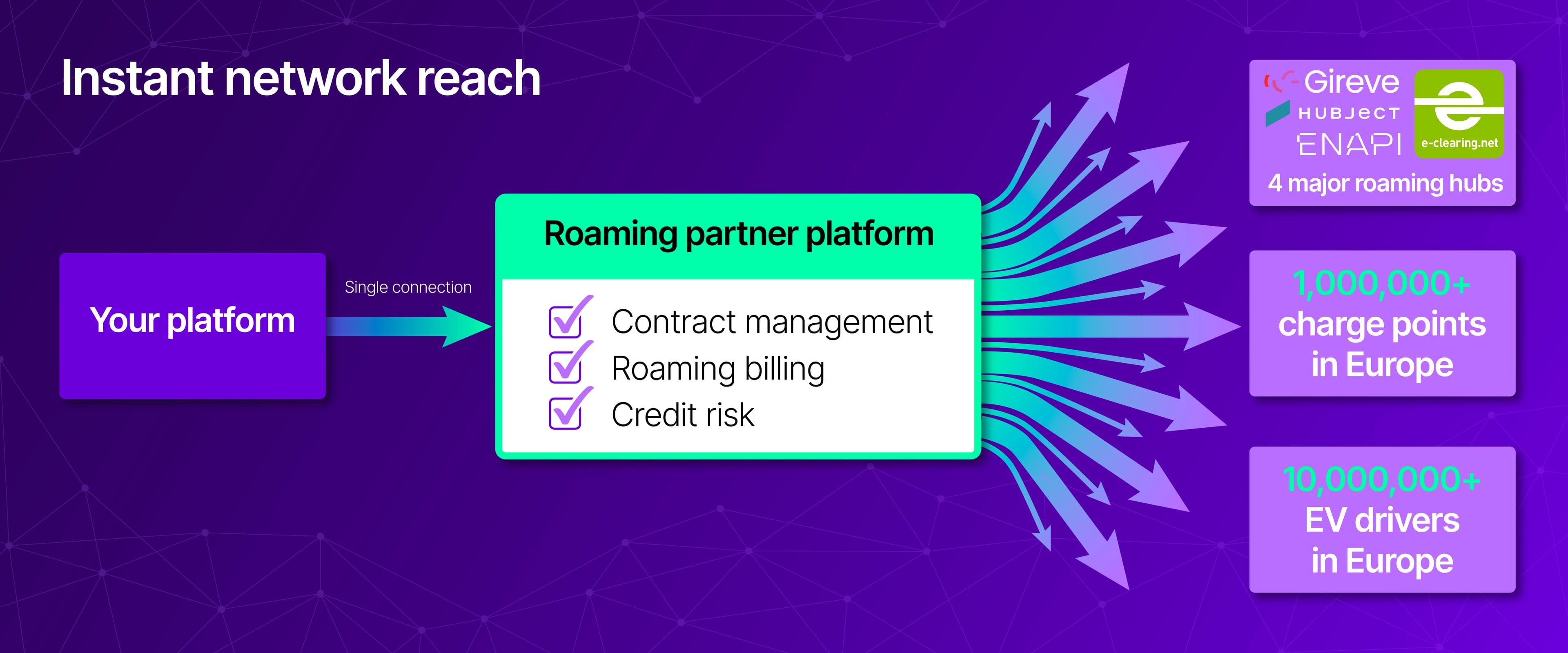
You can instantly connect to thousands of MSPs and CPOs by integrating with a single roaming platform. Unlike connecting directly to roaming hubs – where multiple contracts and integrations are still required – a platform centralises the commercial, technical, and operational relationships into a single agreement. All you have to do is sign one contract, as the platform already manages the technical connections, hub integrations, and roaming relationships behind the scenes. This means fewer negotiations and a far shorter time-to-market.
As a result, your charging network becomes visible and accessible to many more MSPs, giving you access to a larger pool of EV drivers who can now charge on your infrastructure. This is not just great for business visibility but also the first step of turning roaming into revenue.
We are still expanding the network, constantly moving connections away from hubs to direct peers where quality is better.
No need for an in-house roaming team
Since your roaming platform has already completed all of that, the entire team of workers previously mentioned is no longer required, as they have an established team to take care of legalities and continuous optimisation. Instead, you get to hire people whose sole focus lies on the thing you do best: managing your own business.
It’s not only connecting to a hub; it’s managing contracts, managing connections, giving support, and escalating. The majority of questions we get are about invoices, all related to roaming.
Protection from billing and cash-flow risk
An additional layer of protection against bankruptcy is included when you work with roaming as a service offered by a roaming platform provider. Additionally, we handle the whole financial process between two parties at Road. Furthermore, we specifically insure any financial risks to guarantee that everyone is compensated appropriately, even in the event that one party declines to pay for any reason.
For this reason, staying with just one partner would be the safest course of action. An MSP filing for bankruptcy and leaving a CPO unpaid is a plausible scenario. You would need different insurances based on different scenarios to make sure you are protected against this.
You get the network, the quality, and the reliability – without building the machinery behind it.
Plug in once, grow infinitely
Simply put, roaming as a service embodies one idea: one connection, limitless expansion. You can fully concentrate on the expansion of your business rather than having to worry about ongoing updates and shifting legal statuses. As a result, when your connected platform updates when necessary, you are immediately covered for future-proof integrations.
This approach is vastly different from building roaming yourself, as it begins with the aforementioned four roaming hubs across Europe and ends with the constant required rebuild after even the slightest software or legal changes. So, even the first step is significantly easier than the alternative, which leads back to the benefits mentioned earlier.
With a platform managing these connections, you can fully focus on starting, or scaling, your own business. It opens doors to superb customer services or to expanding into new countries, which is in itself made easier with a good roaming connection.
As aforementioned, brand size does not guarantee success nor priority, so the plus side of roaming as a service is that even the smallest companies can establish a well-rounded roaming platform without the hassle.
The barrier to entering the roaming market is so high that even well-known brands struggle to get significant partners to sign.
Buy simplicity, not software
At the end of the day, although roaming in its essence is made up of software, you are not selling a software module but rather a managed service requiring human expertise, monitoring, and legal safeguards. With that, you are to treat it as it is, and this treatment depends on whether you build or buy roaming as a service. If you decide on building your own roaming network, it will likely turn into a business within your business where you need an entire department whose sole job it is to keep your network alive.
In contrast, purchasing roaming entails purchasing a managed service rather than a tool. Contract management, technical maintenance, billing flows, settlement disputes, and fraud monitoring are all human tasks that you outsource. The operational risks can be serious, so this is important. In the worst situations, a dispute over a few missed sessions could cost you hundreds of thousands of euros. This could be disastrous for your company and even lead to its demise. By providing insurance on unpaid invoices and ensuring reimbursements even in the event that something goes wrong, roaming as a service takes on this risk on your behalf.
If you do not have a credit line, which small CPOs hardly ever have, it’s hard to come back from such a setback.
Turning roaming into revenue
There is one aspect of roaming as a service that is often overlooked. Aside from the functionalities, roaming is an excellent way to generate revenue within your company. Adding roaming as a service to your business is necessary for several reasons. Naturally, you want your customers to have the most convenient experience when it comes to charging their cars; that should always be your first priority. Your customers expect undisrupted access to charging wherever they go, and roaming is the only way to guarantee that experience across borders and networks. But roaming also creates a second layer of value that is often overlooked: it turns your charging infrastructure into a place where external drivers can charge as well. Every time a driver from another MSP plugs into your charger, that session becomes revenue you would not have generated on your own.
Building your own roaming network will require a significant initial investment. Naturally, this money must be earned back in some form or another. One option would be to raise your kWh price and charge your customers a higher rate. This is obviously not desirable, as your customer is your top priority. This is why it is best to work with a platform vendor who offers a large network as well as additional services such as contract management, billing, and insurance. This allows you to be open about your pricing as you decide who to work with to get the best deal to keep your prices as honest as possible.
In the end, the choice between building or buying roaming comes down to where you want to invest your time, talent, and resources. If you decide on buying roaming, your primary focus will be on your own business. In-house roaming can be a great source of income, but you must establish it in a way that does not require a large investment in building roaming. Additionally, roaming as a service is the best way to keep your company safe, steady, and trustworthy.
The most important concept to grasp is that roaming as a service is necessary and should help your business grow rather than slow it down.

15 September 2025
Choosing the right platform for EV charging: a security guide for large-scale CPOs
Managing a large EV charging network comes with significant risks: from cyber threats and data misuse to evolving regulations across borders. For CPOs, security cannot be treated as a back-office function; it must be integral to business resilience. This guide outlines the key security principles and credentials to consider when selecting a SaaS partner you can trust.

15 July 2025
The illusion of ownership: buy vs build in EV charging
Everyone craves control. But in reality, a sense of ownership is often just an illusion. In EV charging, and countless other industries, the more control you think you have, the greater your risk of building the wrong thing entirely, sinking years and resources into a problem that has already been solved elsewhere.

01 December 2025
The strategic dilemma behind EV roaming: build it or buy it?
Roaming is one of those things you have to get right, but it’s far from easy. Who do you connect with? How do you manage it all? And how do you make sure it actually works for drivers? Whilst it is one of the more difficult aspects of EV charging, it might be one of the most important ones.